Tracking Financial And Commercial Centre Development
By
Mike Wardle, Professor Michael Mainelli
Published by IFC Review (4 March 2026)
Just over 20 years ago, the Z/Yen Group began work to develop its research on the performance and competitiveness of financial centres. This research developed into the Global Financial Centres Index (GFCI). The index, which has been published every six months from March 2007 onwards, provides a dynamic review of the comparative strengths of financial centres. In September 2025, Z/Yen published the 38th edition of the index.
Alongside the GFCI, Z/Yen has developed two other indices tracking financial and commercial centre performance. The Global Green Finance Index (GGFI), now in its 16th edition, was first published in 2018, and tracks green finance performance. The Smart Centres Index (SCI), now in its 12th edition, followed in 2020. The SCI focuses on innovation and technology.
Each of the indices is a factor assessment index that combines two distinct sets of data to create a rating for each centre in the index:
- Instrumental Factors: Quantitative measures focused on cities and countries provided by a wide range of organisations including the United Nations, OECD, and World Bank.
- Centre Assessments: Ratings of the competitiveness of centres provided by finance and other professionals across the world by means of online questionnaires.
Increasingly, successful commercial cities are those that develop both financial and technology skills and business. Smaller centres are able to compete in specialist areas and particular sectors of finance. The development of new technology provides opportunities for smaller centres to develop innovative strategies and products.
Global Financial Centres Index
Focusing first on the GFCI, the index now tracks 120 financial centres across the world, and the increase in the number of centres covered in the index from 46 centres in the first edition, including Cayman Islands and Bermuda, demonstrates the continuous development of international finance, and the demand for cross-border finance to support trade and commerce.
GFCI 38 Results
New York leads the index, with London second. Hong Kong retains third position ahead of Singapore. The gap between the leading four centres has narrowed and only one rating point separates them. San Francisco, Chicago, Los Angeles, Shanghai, Shenzhen, and Seoul, are unchanged in fifth to tenth positions.
In the separate FinTech Rating contained in the GFCI, Hong Kong takes the top position followed by Shenzhen, with New York falling to third place compared with GFCI 37. Singapore overtook London to take fourth position.
There was a great deal of stability in the rankings at the top of the index. This continues to suggest no major change in the economic outlook across the leading economies in the world, with slightly improving growth and inflation falling. Overall, the rating for almost all centres improved very slightly, with the average rating across all centres up 0.6 per cent.
IFC Performance In The GFCI
Chart 1 shows the GFCI ratings for IFCs over the five years from early 2021 to late 2025. The trend is on average upwards, with a clear upward trend for IFCs since GFCI 31 (March 2022), although some centres in the group have fallen back a little in GFCI 38. Jersey continues to lead the group, although other centres are performing well, with Guernsey, the Isle of Man, and Bermuda, competing for the top place among the group.
Chart 1 | IFC GFCI Ratings Over Five Years
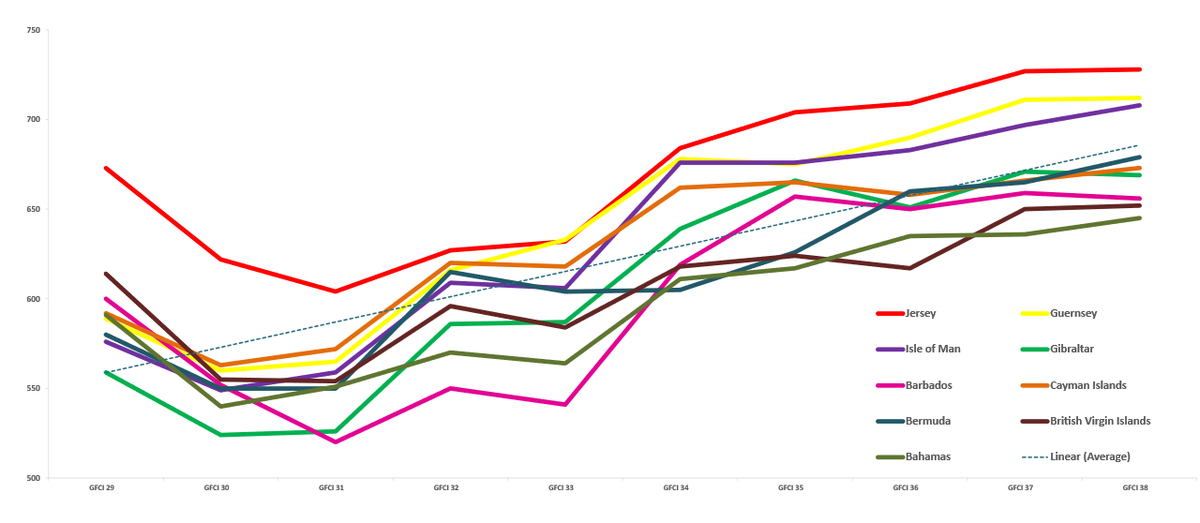
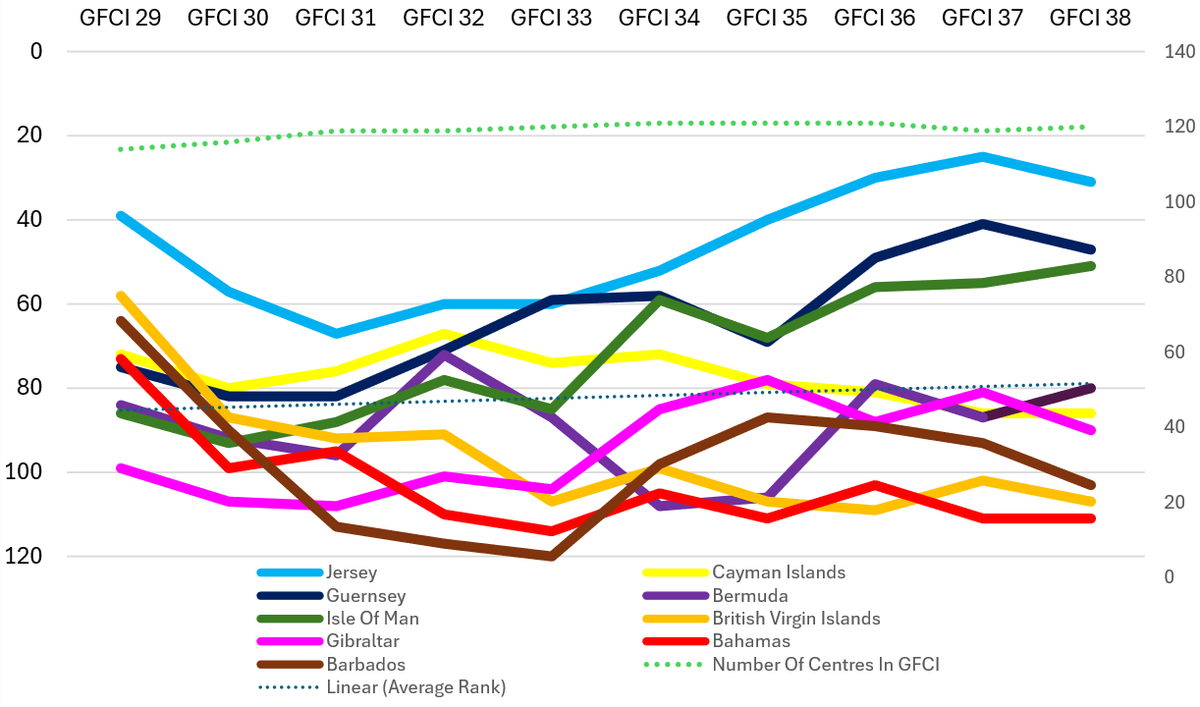
Chart 2 tracks the ranking of IFCs in the GFCI over time. Most centres in the group have fallen back a little in GFCI 38 following improvements in GFCI 37, although the Isle of Man and Bermuda improved and Barbados maintained its rank position. The average rank among these centres has rallied in recent editions since GFCI 36.
Chart 2 | IFC GFCI Rankings Over Five Years
Specialisation & Regional Reputation
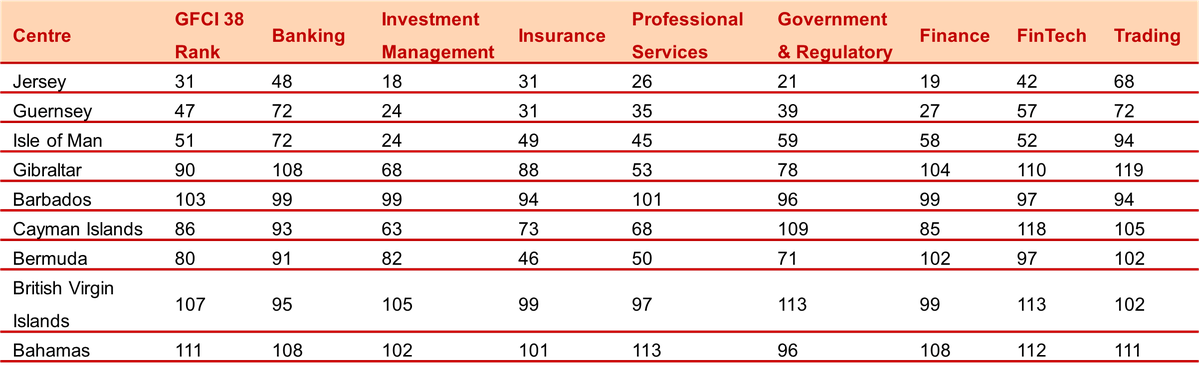
There are sectors of finance in which IFCs’ reputation is particularly strong. Table 1 shows the results of selected industry sector sub-indices that we run using survey assessments from just those working in different sectors of finance. This shows centre strengths, with all IFCs ranking higher than their overall GFCI rank in the insurance sub-index, and all but one ranking higher than their overall GFCI ranking in the investment management and professional services sub-indices. However, all but one IFCs rank lower in the FinTech sub-index (based on the views of people working in FinTech), and all but three rank lower in the banking and trading sub-indices than their overall GFCI result.
These results give an indication of which industry sectors rate IFCs more highly than the overall population of financial professionals: and where specialism leads to success.
Table 1 | IFC Performance in Selected Industry Sub-Indices
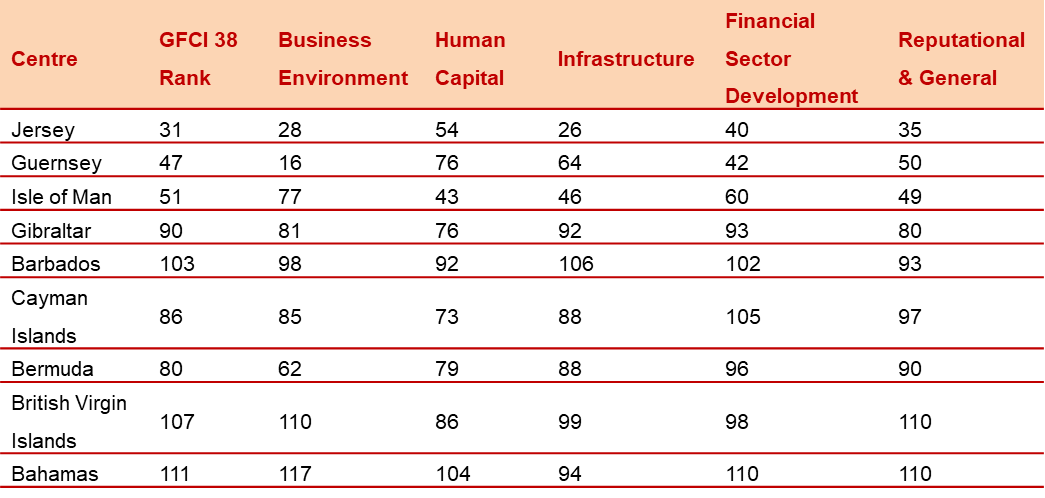
We also produce sub-indices based on groups of instrumental factors – the areas of competitiveness in the GFCI. As Table 2 shows, IFCs generally perform well in the sub-indices relating to human capital (all but two centres improve on their overall GFCI results) and business environment measures (all but three centres score higher than their overall GFCI result). In the other sub-indices, there are mixed results. However, there are successes, with Bahamas performing well in the infrastructure measure; and Gibraltar and Barbados scoring well in the reputation and general area of competitiveness.
Table 2 | IFC Performance In The Areas Of Competitiveness Sub-Indices
We can also analyse the assessments given to centres in the GFCI survey by region. On this measure, the assessments for all IFCs from people based in Western Europe are higher than the global average. The same is true for all but one of the Caribbean IFCs for people based in North America. People in the Middle East & Africa generally rate European IFCs higher than average and Caribbean centres lower than average. People from Asia/Pacific generally rate IFCs below the global average, with the exceptions of the Bahamas, Barbados and Gibraltar.
Green Finance & Technology And Innovation
As indicated earlier, in recent years we have tracked performance in green finance and technology and innovation alongside general financial centre performance.
We can compare IFC performance in the GFCI with their performance in the Global Green Finance Index and Smart Centres Index. In this comparison, Caribbean IFCs generally perform better for green finance and in the Smart Centres Index than in the GFCI. European IFCs perform generally worse on green finance than their GFCI performance, but better for technology and innovation. There may be further opportunities for IFCs to develop their green finance offering.
Table 3 | Comparative Performance Of IFCs In The GFCI, GGFI, And SCI
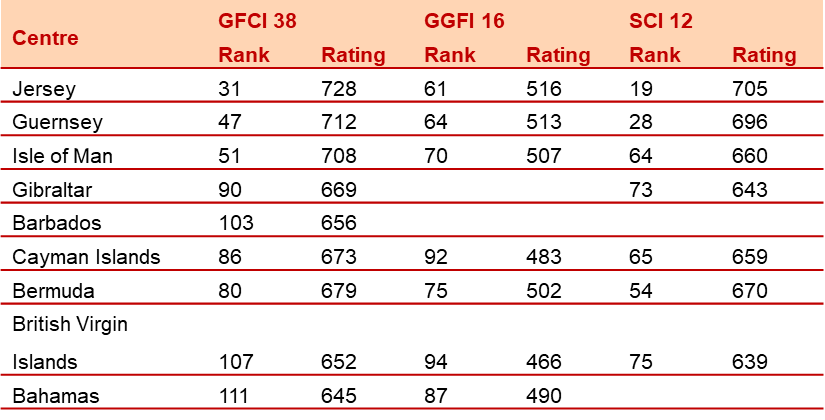
Note: A blank entry means that that centre does not yet feature in the GGFI or SCI.
The Impact Of Regulatory Approaches
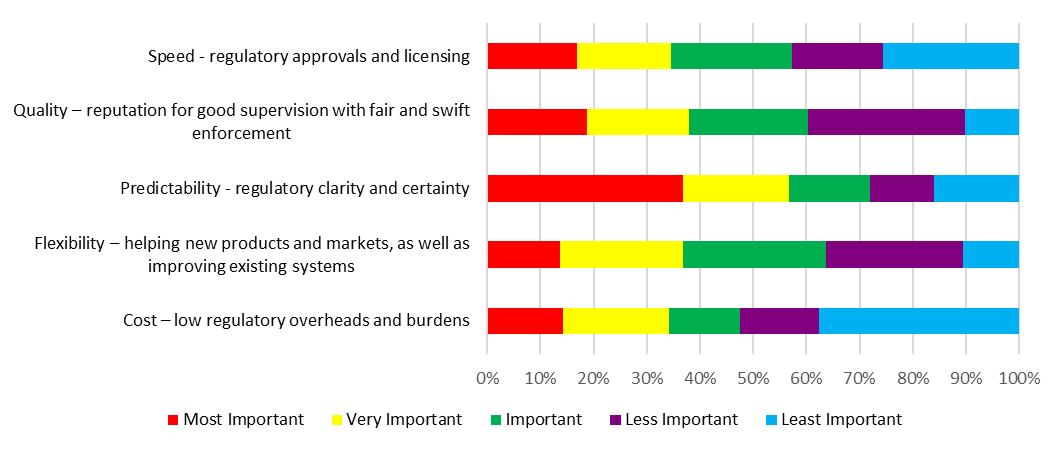
One of the factors that is regularly cited as important in financial and commercial centre development is the approach to regulation in the centre or jurisdiction. We recently researched views on the aspects of regulation that are most important to the development of financial centres, looking at:
Predictability was seen by respondents as the most important factor in regulatory systems, with almost 40 per cent of respondents giving it the highest priority. Quality, flexibility, and speed came next in order of importance, with cost ranking lowest for importance, and with almost 40 per cent of respondents giving it the lowest priority. This suggests that successful centres will focus on the predictability of regulation.
Chart 3 | Regulatory Factors Ranked By Importance
Into The Future
There continue to be opportunities for IFCs to focus on their specialist expertise. In a world where technology is affecting all aspects of business and each of our lives, it will be important to ensure that there is investment in technological skills, and in regulatory and other support systems that encourage innovation. The financial centre of the future will be one where skills, the business environment, regulation, and infrastructure are focused on enabling innovation and harnessing technology to drive business.