Authors
Mike Wardle, Professor Michael Mainelli
Published by
Long Finance & Financial Centre Futures (March 2026), 61 pages. Produced by Z/Yen in partnership with CDI.
Share on social media:


You might also be interested in:


The Global Financial Centres Index 39
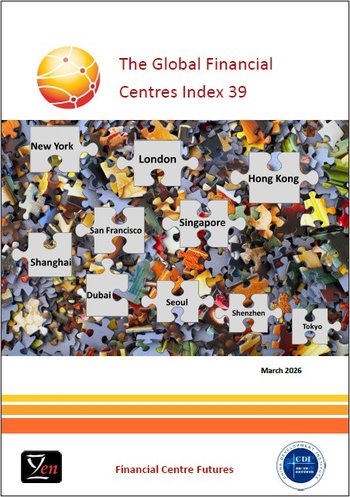
The thirty-ninth edition of the Global Financial Centres Index (GFCI 39) was published on 26 March 2026. GFCI 39 provides evaluations of future competitiveness and rankings for 120 financial centres around the world. The GFCI serves as a valuable reference for policy and investment decision-makers.
China Development Institute (CDI) in Shenzhen and Z/Yen Partners in London collaborate in producing the GFCI. The GFCI is updated and published every March and September, and receives considerable attention from the global financial community.
137 financial centres were researched for GFCI 38 of which 120 are in the main index. The GFCI is compiled using 147 instrumental factors. These quantitative measures are provided by third parties including the World Bank, the OECD, and the United Nations.
The instrumental factors are combined with financial centre assessments provided by respondents to the GFCI online questionnaire. GFCI 39 uses 34,468 assessments from 5,218 respondents.
GFCI 39 Results
Leading Centres
- New York leads the index, with London second. Hong Kong retains third position ahead of Singapore.
- San Francisco is unchanged in fifth position and Shenzhen remains in ninth place. Shanghai and Seoul are both up two places, and Dubai and Tokyo enter the top 10, replacing Chicago and Los Angeles.
Western Europe
- London continues to lead in the region, with seven Western European centres featuring in the top 20 in GFCI 39.
- The average rating across this region fell by 1.6%.
- Only London and Madrid improved their ratings in comparison with GFCI 38.
Asia/Pacific
- Six Asia/Pacific centres feature in the world top 10.
- The average rating for this region is down 1.27% compared with GFCI 38.
- Just three centres in the region rose in the ratings.
North America
- New York and San Francisco remain in the world top 10, with Los Angles, Boston, Chicago, and Washington DC also in the top 20.
- On average, ratings for centres in this region fell 1.8%.
- All centres in the region fell in the ratings other than New York.
Eastern Europe & Central Asia
- Astana remains in the lead position in the region, with Cyprus rising 23 places to second place in the region and Warsaw maintaining third place.
- The average rating change across this region decreased 0.56% with just four centres in the region improving their rating.
- Eleven of the 14 centres in the region improved their rank position.
Middle East & Africa
- Dubai and Abu Dhabi continue to take first and second places in the region, with Dubai entering the top 10 to take seventh place.
- Doha rose 14 places to take third place in the region, with Casablanca in fourth place – and the leading centre in Africa.
- The average rating change across this region was a fall of 1.23%.
- Along with Doha, Johannesburg was up 14 places, while Kuwait City rose 16 places. These centres were the only ones to increase their rating.
Latin America & The Caribbean
- Following an increase in the last edition, Bermuda rose a further twenty-three rank places to maintain its lead in the region, ahead of Cayman Islands and Santiago.
- The British Virgin Islands was the only other regional centre to improve its rank position – up 10 places.
- Average ratings in the index fell by 2.5% in the region, with the British Virgin Islands maintaining its rating and other than the leading centres in the region, only Buenos Aires improving its rating.
FinTech
- We are able to assess 116 centres for their FinTech offering.
- There is no change among the top five places in the FinTech rankings, with Hong Kong in top position followed by Shenzhen, New York, Singapore, and London.
- Casablanca, Monaco, Almaty, and Sofia improved by 20 or more places in the FinTech rankings. Calgary fell 27 places and Tianjin fell 16 places.