Communities Over Cash - Rethinking Global Cooperation On Housing
By
Professor Michael Mainelli
Published by "A Global Housing Crisis: Why Housing Defines The Future Of Global Development", Global Policy Analysis, Number 12, Nizami Ganjavi International Center (May 2026), pages 46-49.
The Framing Error
The global housing crisis is real, but not a global problem. Let me explain. Nearly three billion people live in substandard conditions. Over one billion occupy informal settlements. More than 300 million have no home at all. The numbers are vast, and the temptation when confronting vast numbers is to reach for vast solutions — grand international targets, multilateral frameworks, massive public expenditure programmes, sweeping architectural interventions.
That temptation should be resisted. Not because ambition is wrong, but because the framing is. Housing is not a global problem. It is a problem shared globally. The distinction matters enormously. A global problem implies a global solution — a universal mechanism, a centralised response, a single lever that, if pulled hard enough, fixes everything everywhere. But housing does not work that way. A family in Baku, a community in Nairobi, a neighbourhood in Bogotá — each faces a housing challenge shaped by its own land tenure arrangements, its own planning culture, its own economic base, its own history. The solutions, virtually every one of them, are local, not global.
What global cooperation can do — and what it should focus on doing — is to help share the components of those solutions, what works, what doesn’t work. Successful mechanisms, financial instruments, governance innovations, legal frameworks: these can travel. It’s facile to say we just need more money. The insight must be that we need better systems, and systems can be learned, adapted, improved, and exported.
Why Money Is Not the Answer
Too many infrastructure projects, housing included, treat lack of cash as their primary excuse for failure — for poor quality, late delivery, reduced scope. In part, they may be correct. But only in part, and usually the smaller part.
Money is a technology. It is a tool that communities use to trade debts across space and time. When we treat it as the fundamental constraint, we obscure what is actually fundamental: the community itself. A persistent community — one whose members are genuinely prepared to be indebted to one another in pursuit of a shared goal — can accomplish things that no quantity of externally provided finance can substitute for.
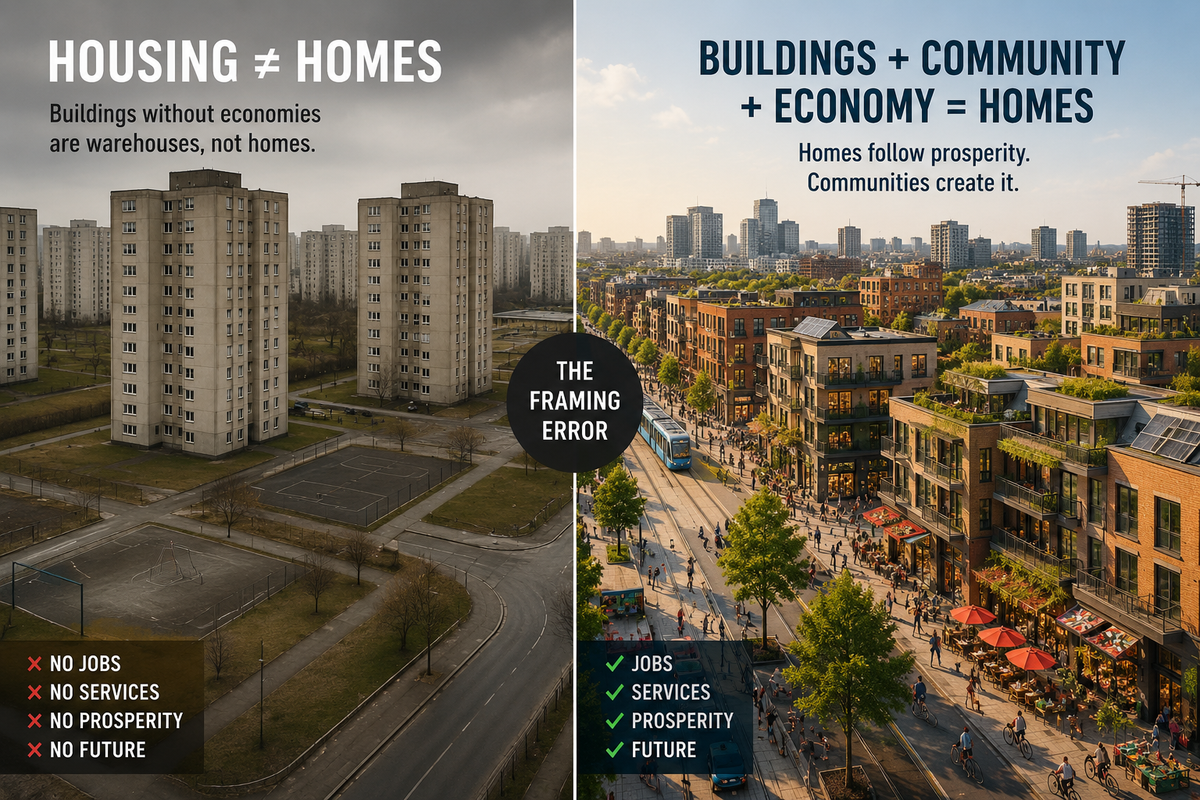
This is the core argument for a whole-systems approach to housing. Cash matters, but it is downstream of something more important: the capacity of a community to organise itself, to generate economic activity, to create the conditions in which people can prosper. Housing follows prosperity. It does not precede it.
This is not a counsel of passivity. It is a call for a more sophisticated understanding of what global cooperation should actually be building.
What Works: The Toolkit
Several decades of experience — in urban finance, land governance, public-private partnership, and municipal policy — have produced a well-stocked toolkit. The challenge is not invention; it is dissemination and adaptation. Here are some local instruments worthy of global attention:
- Land value capture and land value taxation. When public investment — infrastructure, transport links, planning permissions — increases the value of land, that uplift should flow back to the community that created it, not exclusively to the landowner who happened to hold the title. This is not a radical idea. Hong Kong, which was poorer per capita than Jamaica in 1960, built one of the world's most extraordinary urban economies in part by capturing land value systematically, charging a community rate on land rights rather than allowing all gains to privatise. MTR's and Japanese National Railway’s celebrated "rail plus property" models — where the transit authority develops land around new stations and captures the resulting value uplift — is a direct descendant of that philosophy, and is studied and replicated across Asia. The City of London's contribution to funding the Elizabeth Line — one of the most significant pieces of urban infrastructure in recent European history — drew substantially on land value capture mechanisms. Georgist economics and the Garden Cities movement understood this a century ago. The wheel does not need reinventing; it needs fitting to more vehicles.
- Brownfield land reuse through public guarantees. One of the most significant barriers to urban regeneration is uncertainty about the cost of cleaning contaminated land. Private developers price this risk conservatively, often prohibitively. Public sector guarantees on remediation insurance — underwriting the uncertainty rather than the cost — can unlock sites that would otherwise remain derelict for decades. This is a relatively low-cost public intervention with potentially transformative effects on urban land supply.
- Mutual maintenance insurance captives. The failure mode of much social and affordable housing is not construction; it is maintenance. Buildings deteriorate, common areas degrade, communities fragment. Mutual insurance structures — where residents collectively pool risk and benefit from good maintenance behaviour — align incentives in ways that conventional landlord-tenant arrangements do not. They create communities with a financial stake in their own environment.
- Performance and policy bonds. Conventional project finance addresses construction risk tolerably well. It addresses policy risk and demand risk much less well. Surety bonds and performance bonds can be structured to cover not just whether a building is delivered on time and to specification, but whether the policy environment remains stable, whether occupancy targets are met, whether maintenance standards are sustained over decades. Sovereign sustainability-linked bonds — where a government's borrowing costs are explicitly tied to climate change targets, would work equally well on housing and urban development outcomes. Financial commitments make policy commitments credible in a way that declarations alone cannot.
- The Danish mortgage model. For over two centuries, Denmark has operated a covered bond mortgage system that has consistently delivered among the lowest long-term mortgage rates in the world, through multiple financial crises, including 2008. The model is technically complex but conceptually elegant: mortgage bonds are matched precisely to the underlying loans, creating transparency and stability. Its exportability has been underexplored. Variants adapted to different legal and regulatory contexts could transform access to long-term housing finance in many markets.
- Tax administration modernisation, particularly e-invoicing. This may seem an unlikely entry in a housing toolkit, but it belongs here. Informal settlements persist in part because the formal economy is too costly and too opaque to participate in. Streamlined, digital tax administration — e-invoicing systems that reduce the friction of economic formality — draws economic activity into the light, broadens the tax base, and gives governments the fiscal capacity to invest in housing and infrastructure. The connection between good tax administration and adequate housing is real, if underappreciated.
The Urban Realm as Economic Argument
Cities are co-located networks of human networks. Almost everything that connects people — physically, socially, commercially, intellectually — increases the probability of prosperity. Author, theorist, and activist Jane Jacobs understood and explained this - “Cities have the capability of providing something for everybody, only because, and only when, they are created by everybody.” So did celebrated Peruvian economist Hernando de Soto, who spent his career documenting how the absence of property rights and the rule of law traps communities in informality, denying them the ability to leverage their assets, access credit, or participate fully in economic life.
The implication is important: housing policy that ignores economic policy is incomplete by design. The question is never simply "how do we build more homes?" It is always "how do we build communities in which people can prosper, and which therefore generate the demand and the resources for adequate housing?" The answer to the second question contains the answer to the first.
This whole-systems framing also explains why the great failures of housing policy have tended to share a common structure. They have treated housing as an isolated architectural problem, or as a public expenditure problem, in isolation from the economic and social ecosystem in which housing sits. The results — the notorious social housing disasters of the mid-twentieth century, the PPP and PFI scandals that left governments holding liabilities for buildings nobody wanted to live in — were predictable in retrospect. Buildings without economies are warehouses, not homes.
What WUF13 Might Build
The World Urban Forum in Baku is an opportunity. The risk at any large multilateral gathering is that it produces commitments without mechanisms — declarations of intent that dissipate on contact with the complexity of implementation.
WUF13 might put the focus on building infrastructure for knowledge transfer. Not another framework. A working exchange: city to city, finance ministry to finance ministry, land registry to land registry. The instruments described above are not secret. They are documented, studied, and in many cases proven. What is missing is the sustained, practical, technically detailed conversation that allows them to be understood and adapted.
Human dignity begins with self-worth — with the sense that one is contributing to something, building something, participating in something larger than oneself. That dignity requires not just a roof, but a community based on a successful economy. Global cooperation on housing should be in the business of building both. If we give people the means to prosper, they will take them. That is the most reliable housing policy ever devised.
Professor Michael Mainelli is Chairman of the City of London’s leading commercial think-tank, Z/Yen. He served as Lord Mayor of London 2023–2024. He is co-founder of the New Garden Cities Alliance and a Visiting Professor at UCL's Bartlett School focusing on Sustainable Construction.
Full report - "A Global Housing Crisis: Why Housing Defines The Future Of Global Development", Global Policy Analysis, Number 12, Nizami Ganjavi International Center (May 2026), pages 46-49 - https://www.nizamiganjavi-ic.org/uploads/journal/19/15b604faf296a54b561f1a1fd7dcdabf.pdf?v=1779802436